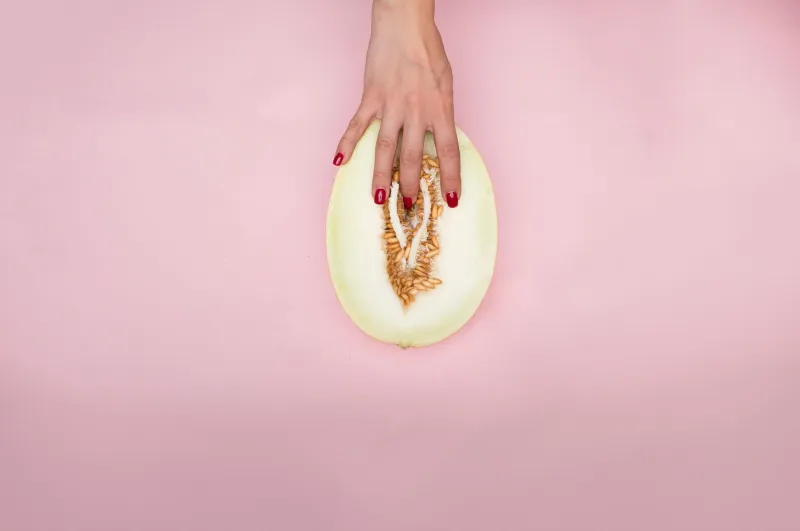
You Can't Love What You Don't Know: The Case for Getting Familiar With Your Own Vulva

There's a thing that happens in sex ed — and in most of American culture, honestly — where we hand people a vague map of their own bodies and then act surprised when they can't find their way around. We teach kids the word "vagina" as a catch-all for everything south of the waistline, skip the clitoris entirely, and then wonder why so many people grow up feeling like strangers in their own skin.
Here's the uncomfortable math: if you can't name it, you probably can't ask for what you need from it. And if you can't ask, you probably aren't getting it.
Vulva literacy — a term that sounds clinical but is really just shorthand for knowing your own stuff — turns out to be one of the most underrated predictors of sexual satisfaction we've got.
What the Research Actually Says
Studies on sexual self-concept consistently show that people with higher body awareness report more frequent orgasms, greater satisfaction with their sex lives, and stronger communication with partners. A 2016 study published in the Journal of Sex Research found that genital self-image was significantly correlated with sexual function — not in a "you need to love how you look" way, but in a practical, functional sense. People who were familiar with their own anatomy were more likely to know what felt good, communicate that to a partner, and notice when something was off.
That last part matters more than people realize. Knowing your baseline — what your vulva looks like, how your discharge normally behaves, what your labia feel like on a regular Tuesday — is what lets you catch an infection early, recognize an unusual texture, or notice that something has changed. It's not vanity. It's maintenance.
And yet, a surprising number of people have never actually looked. A 2021 survey by INTIMINA found that nearly half of women in the US felt uncomfortable using the correct anatomical terms for their own genitals. Half. That's not a personal failing — that's a cultural one.
The Confidence-Communication Loop
Here's how it tends to work: when you know your body, you can describe what you want. When you can describe what you want, partners can actually deliver it. When partners can deliver it, sex gets better. When sex gets better, you feel more confident. When you feel more confident, you're more likely to explore and stay curious about your own body.
It's a loop. And it starts with the first step, which is just... looking.
Sexual confidence isn't some mystical quality that certain people are born with. It's mostly just accumulated self-knowledge. The people who seem effortlessly comfortable in bed have usually spent some time — alone, without pressure — figuring out what their body actually does and likes.
The good news? This is genuinely learnable. It's not talent. It's practice.
Body Mapping: A Practical Place to Start
Body mapping sounds fancy, but it's essentially just a structured way of getting to know yourself. Here's a low-pressure version:
Start with a mirror. A handheld mirror, good lighting, and about ten uninterrupted minutes. You're not judging. You're just looking. Note the shape of your labia majora and minora (they're almost certainly asymmetrical — most are). Find your clitoral hood. Look at your vaginal opening. This is your baseline.
Make it a monthly habit. Gynecologists recommend monthly breast self-exams for a reason — familiarity lets you catch changes. The same logic applies below the belt. A quick visual check once a month means you'll notice if something looks different.
Touch with curiosity, not performance. This isn't about getting turned on (though that's fine if it happens). It's about mapping sensation. What areas are more sensitive? What kind of touch feels neutral versus pleasurable? Where is pressure comfortable versus uncomfortable? You're gathering data.
Write it down if that helps. Some people find it useful to actually journal what they discover — not in a clinical way, just notes. "More sensitive on the left side." "Pressure near the clitoral hood feels better than direct touch." This kind of self-knowledge is gold when you're trying to communicate with a partner.
The Language Problem
One thing that makes all of this harder is that we genuinely lack good, neutral vocabulary. "Vagina" gets used to mean everything when it technically refers only to the internal canal. "Privates" implies shame. Slang terms carry their own baggage.
Practicing the actual anatomical terms — vulva, labia majora, labia minora, clitoris, clitoral hood, vaginal opening, perineum — isn't pedantic. It's useful. It's the difference between being able to tell a doctor exactly where something hurts and waving vaguely at your lap and saying "down there."
It also matters in bed. Partners who receive specific feedback ("a little to the left," "softer," "right there") can respond to it. Partners who receive vague signals mostly just guess. Anatomical language isn't a buzzkill — it's a cheat code.
When Self-Knowledge Saves You a Scary Appointment
The medical case for vulva literacy is real and underappreciated. People who know their own anatomy are more likely to recognize the early signs of yeast infections, bacterial vaginosis, or contact dermatitis — and less likely to let things fester because they assumed it was "just normal."
They're also better equipped to advocate for themselves in medical settings. If you can describe your symptoms specifically, you're less likely to be dismissed. And dismissal, unfortunately, is a documented problem: studies show that women's pain is consistently undertreated compared to men's, and that patients who use precise language get taken more seriously.
Knowing your body is a form of self-advocacy. It's not optional — it's protective.
The Bottom Line
You don't need to become a vulva expert overnight. You don't need to love every inch of yourself with some kind of fierce, Instagram-caption enthusiasm. You just need to know what's there.
Because the confidence gap between people who have great sex and people who don't isn't usually about technique or luck or finding the right partner. It's often just about familiarity. The people who know their bodies show up to sex with a map. Everyone else is guessing in the dark.
Grab a mirror. Start there.